Listen to Louis D. Brandeis: A Life by Melvin Urofsky
Enjoy this audiobook with MP3 Audiobook Player - the ultimate iOS audiobook experience
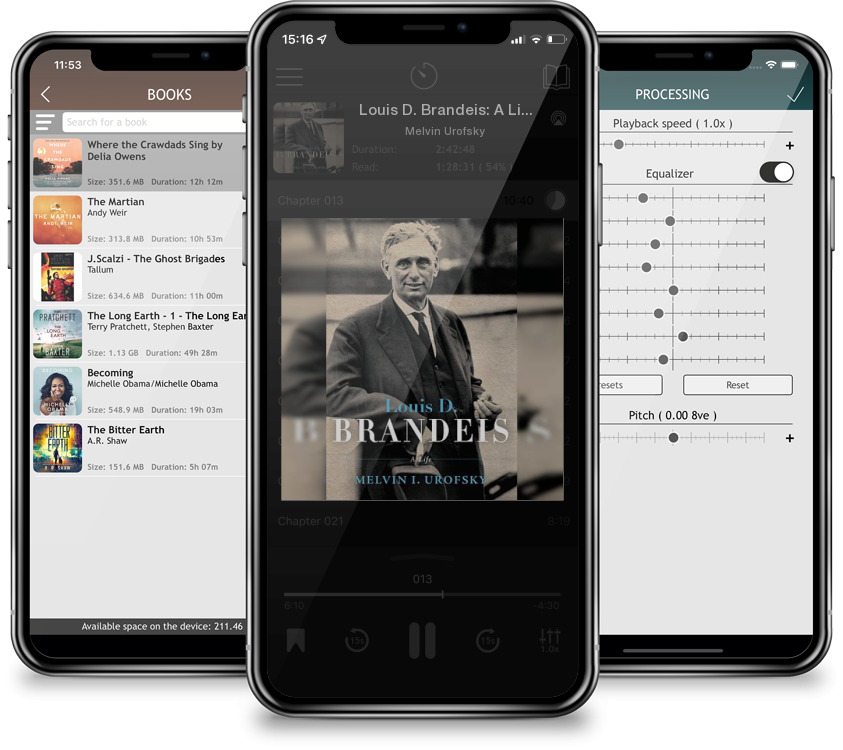
The first full-scale biography in twenty-five years of one of the most important and distinguished justices to sit on the Supreme Court–a book that reveals Louis D. Brandeis the reformer, lawyer, and jurist, and Brandeis the man, in all of his complexity, passion, and wit. Louis Dembitz Brandeis had at least four “careers.” As a lawyer in the late nineteenth and early twentieth centuries, he pioneered how modern law is practiced. He, and others, developed the modern law firm, in which specialists manage different areas of the law. He was the author of the right to privacy; led the way in creating the role of the lawyer as counselor; and pioneered the idea of pro bono publico work by attorneys. As late as 1916, when Brandeis was nominated to the Supreme Court, the idea of pro bono service still struck many old-time attorneys as somewhat radical. Between 1895 and 1916, when Woodrow Wilson named Brandeis to the Supreme Court, he ranked as one of the nation’s leading progressive reformers. Brandeis invented savings bank life insurance in Massachusetts (he considered it his most important contribution to the public weal) and was a driving force in the development of the Federal Reserve Act, the Clayton Antitrust Act, and the law establishing the Federal Trade Commission.Brandeis as an economist and moralist warned in 1914 that banking and stock brokering must be separate, and twenty years later, during the New Deal, his recommendation was finally enacted into law (the Glass-Steagall Act of 1933) but was undone by Ronald Reagan, which led to the savings-and-loan crisis in the 1980s and the world financial collapse of 2008.We see Brandeis, who came from a family of reformers and intellectuals who fled Europe and settled in Louisville. Brandeis the young man coming of age, who presented himself at Harvard Law School and convinced the school to admit him even though he was underage. Brandeis the lawyer and reformer, who in 1908 agreed to defend an Oregon law establishing maximum hours for women workers, and in so doing created an entirely new form of appellate brief that had only a few pages of legal citation and consisted mostly of factual references.Urofsky writes how Brandeis witnessed and suffered from the anti-Semitism rampant in the early twentieth century and, though not an observant Jew, with the outbreak of the Great War in 1914, became at age fifty-eight head of the American Zionist movement. During the next seven years, Brandeis transformed it from a marginal activity into a powerful force in American Jewish affairs. We see the brutal six-month confirmation battle after Wilson named the fifty-nine-year-old Brandeis to the court in 1916; the bitter fight between progressives and conservative leaders of the bar, finance, and manufacturing, who, while never directly attacking him as a Jew, described Brandeis as “a striver,” “self-advertiser,” “a disturbing element in any gentleman’s club.” Even the president of Harvard, A. Lawrence Lowell, signed a petition accusing Brandeis of lacking “judicial temperament.” And we see, finally, how, during his twenty-three years on the court, this giant of a man and an intellect developed the modern jurisprudence of free speech, the doctrine of a constitutionally protected right to privacy, and suggested what became known as the doctrine of incorporation, by which the Bill of Rights came to apply to the states. Brandeis took his seat when the old classical jurisprudence still held sway, and he tried to teach both his colleagues and the public– especially the law schools–that the law had to change to keep up with the economy and society. Brandeis often said, “My faith in time is great.” Eventually the Supreme Court adopted every one of his dissents as the correct constitutional interpretation. A huge and galvanizing biography, a revelation of one man’s effect on American society and jurisprudence, and the electrifying story of his time.

I'm constantly amazed by the variety of genres – there's something for everyone. Effortlessly managing my audiobook collection – this app's functionality is a winner. ListenBook is my go-to app for audiobooks. It's like having a personal assistant for my literary adventures.

Navigating audiobooks seamlessly – this app's design is a true winner. Audiobook excellence made simple – this app's functionality is a true asset.

With ListenBook, I can keep track of my audiobook consumption and explore new content with ease. The vast selection of titles on this app is a book lover's dream come true. The narrators' voices on this app are so soothing – it's my relaxation therapy.

This app has turned long waits into exciting opportunities to dive into a new story. 📱 Accessing my favorite stories has never been this straightforward – this app's functionality is a bookworm's dream come true. 📚💫 Navigating through chapters is a breeze. I can easily jump to the parts I want to listen to. Great for listening to lectures and educational content. Very useful!

I've become a more empathetic listener and reader, thanks to the power of audiobooks. The interface is beautiful and functional. ListenBook is my go-to app for audiobooks.

This app's compatibility with different formats ensures that I never miss out on a great audiobook. 🌟 Adding excitement to everyday tasks – this app is my partner in productivity! 📚🚀 ListenBook's tone adjustment feature in the Pro version is a creative tool that adds a fun twist to my audiobook journey. ListenBook has become an essential part of my daily routine. It's like having a library on my phone! The app is perfect for people who love to multitask. I can listen while cooking.
Plays MP3, MP4, OPUS, OGG, FLAC, AWB, M4B, M4A, WMA, AAC formats
Optimized for iPhone, iPad, and iPod with seamless integration
Adjust playback speed from 0.5x to 3.0x for your listening preference
Import audiobooks via iTunes, cloud services, or direct downloads
Get your favorite audiobooks in supported formats from various sources
Import audiobooks to MP3 Audiobook Player using multiple methods
Control playback from your device, headphones, Apple Watch, or CarPlay
Join thousands of users who enjoy audiobooks with MP3 Audiobook Player daily
Download Now