Listen to DEWEY DECIMAL CLASSIFICATION, 2021 (Schedules 600-999) (Volume 3 of 4) (Abridged / Paperback) by Inc Oclc
Enjoy this audiobook with MP3 Audiobook Player - the ultimate iOS audiobook experience
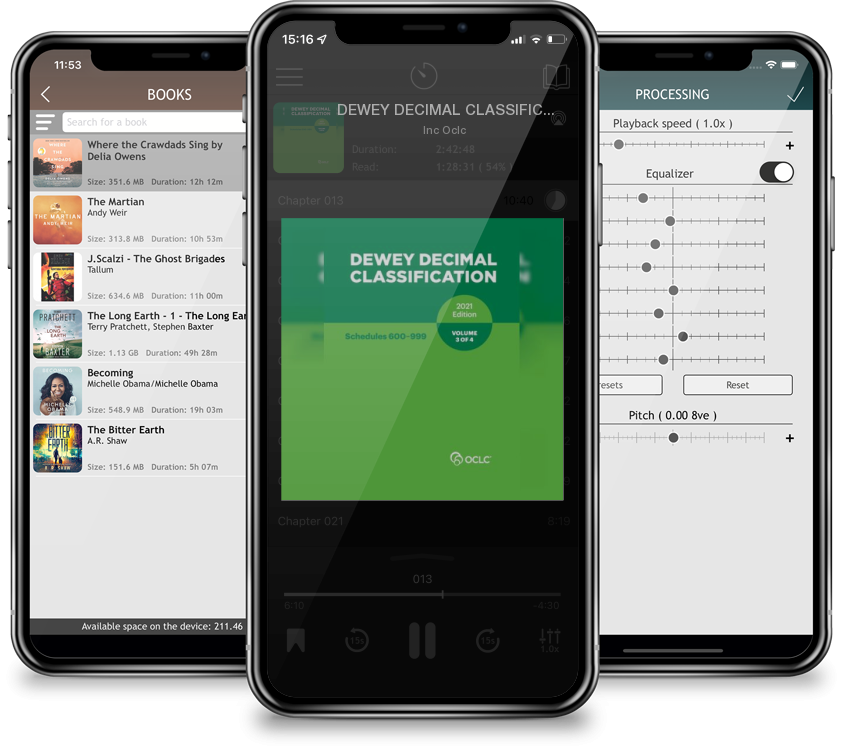
This 2021 version of the Dewey Decimal Classification.DEWEY DECIMAL CLASSIFICATION, 2021 (Schedules 600-999) (Volume 3 of 4) Classification: What It Is and What It Does Classification provides a system for organizing knowledge. Classification may be used to organize knowledge represented in any form, e.g., books, documents, electronic resources. Notation is the system of symbols used to represent the classes in a classification system. In the Dewey Decimal Classification, the notation is expressed in Arabic numerals. The notation gives both the unique meaning of the class and its relation to other classes. The notation provides a universal language to identify the class and related classes, regardless of the fact that different words or languages may be used to describe the class.History, Current Use, and Development of the Dewey Decimal Classification The Dewey Decimal Classification-conceived by Melvil Dewey in 1873 and first published in 1876-is a general knowledge organization tool that is continuously revised to keep pace with knowledge. The system is further extended through number building, interoperable translations, association with categorized content, and mappings to other subject schemes. The DDC is published by OCLC, Inc. The DDC is accessed through WebDewey, a frequently updated subscription service maintained by OCLC. OCLC owns all copyright rights in the Dewey Decimal Classification and licenses the system for a variety of uses. The DDC is the most widely used classification system in the world. Libraries in more than 138 countries use the DDC to organize and provide access to their collections, and DDC numbers are featured in the national bibliographies of more than sixty countries. Libraries of every type apply Dewey numbers on a daily basis and share these numbers through a variety of means (including WorldCat). Dewey is also used in a variety of applications on the web in support of categorization, browsing, and retrieval. The DDC has been translated into over thirty languages. Since 1988, authorized translations of the full and abridged editions of the DDC have been published or are under way in Arabic, French, German, Greek, Hebrew, Icelandic, Indonesian, Italian, Norwegian, Russian, Spanish, Swedish, Turkish, and Vietnamese. The DDC Summaries, the top three levels of the Dewey Decimal Classification system, have been translated into Afrikaans, Arabic, Chinese, Czech, French, German, Hebrew, Italian, Norwegian, Portuguese, Russian, Spanish, Swedish, and Vietnamese. One of Dewey's great strengths is that the system is developed and maintained in a national bibliographic agency, the Library of Congress. The Dewey editorial office is located in the Dewey Section of the Library of Congress, where classification specialists annually assign over 60,000 DDC numbers to records for works cataloged by the Library. Having the editorial office within the Dewey Section enables the editors to detect trends in the literature that must be incorporated into the Classification. The editors prepare proposed schedule revisions and expansions and forward the proposals to the Decimal Classification 3 Editorial Policy Committee (EPC) for review and recommended action. EPC is a ten-member international board whose main function is to advise the editors and OCLC on matters relating to changes, innovations, and the general development of the Classification. EPC represents the interests of DDC users; its members come from national, public, special, and academic libraries, and from library schools.

I love that ListenBook Pro allows me to customize the tone of the sound – it adds a personal touch. With this app, reading has become an integral part of my daily routine. Finally, an app that lets me organize my audiobooks effortlessly. The library organization and book groups feature make navigation a breeze. A decent listen overall. The narration was clear, though some character voices sounded similar. The story was interesting but had moments where it dragged slightly. Still, it was a good way to pass the time.

ListenBook's sharing options make it easy for me to connect with fellow audiobook enthusiasts. ListenBook has seamlessly integrated into my daily routine, enhancing my workouts, commutes, and moments of relaxation. It's a true companion. The import process is seamless. I had no trouble adding my audiobooks.

Navigating audiobooks seamlessly – this app's design is a true winner. Audiobook immersion without complications – this app's ease of use is commendable. Absolutely loved the narration! The voice actor brought the characters to life with distinct tones and emotions. The production quality was top-notch, with no background noise or distractions. A truly immersive experience!

ListenBook's focus on quality and user experience has made it my go-to app for audiobooks and educational content. Say hello to audiobook nirvana! This app's user-friendly design and comprehensive features have made my reading routine smoother than ever. 🌌📚 Automatic artwork and metadata extraction keep my audiobook library organized and visually appealing. The app's integration with CarPlay enhances my road trips with immersive audiobook journeys.

ListenBook's commitment to providing a high-quality audiobook experience is truly commendable. ListenBook Pro's noise reduction feature is a game-changer. It enhances the audio quality and ensures that I can immerse myself fully in the content.

I'm impressed by how this app seamlessly syncs across my devices. ListenBook is the best audiobook player I’ve ever used. The app is packed with features like customizable skip intervals, playback speed, and sleep timers. The interface is clean and easy to navigate, making it a joy to use. Five stars! This audiobook made my workouts fly by! The engaging narration kept me motivated to keep listening, which meant longer gym sessions. The narrator's energy matched the material perfectly - upbeat when needed, somber when appropriate. A great example of how narration can enhance text. The narrator's voice was so pleasant and easy to listen to. They had perfect pacing and made even the slower parts engaging. I found myself looking forward to my commute just to listen more!
Plays MP3, MP4, OPUS, OGG, FLAC, AWB, M4B, M4A, WMA, AAC formats
Optimized for iPhone, iPad, and iPod with seamless integration
Adjust playback speed from 0.5x to 3.0x for your listening preference
Import audiobooks via iTunes, cloud services, or direct downloads
Get your favorite audiobooks in supported formats from various sources
Import audiobooks to MP3 Audiobook Player using multiple methods
Control playback from your device, headphones, Apple Watch, or CarPlay
Join thousands of users who enjoy audiobooks with MP3 Audiobook Player daily
Download Now