Listen to Dialectic of Enlightenment (Cultural Memory in the Present) by Max Horkheimer
Enjoy this audiobook with MP3 Audiobook Player - the ultimate iOS audiobook experience
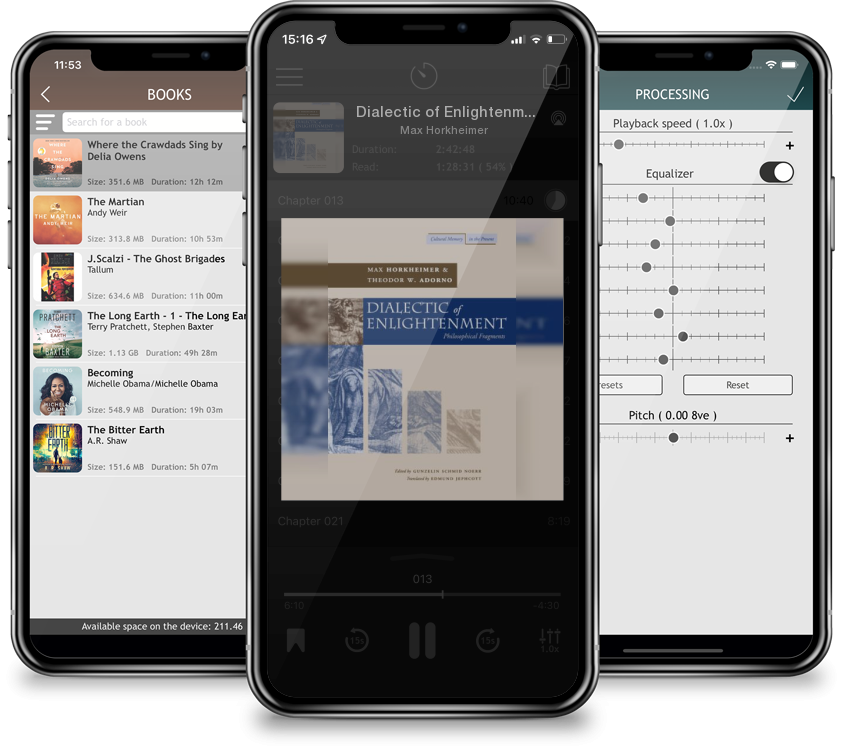
Dialectic of Enlightenment is undoubtedly the most influential publication of the Frankfurt School of Critical Theory. Written during the Second World War and circulated privately, it appeared in a printed edition in Amsterdam in 1947. What we had set out to do, the authors write in the Preface, was nothing less than to explain why humanity, instead of entering a truly human state, is sinking into a new kind of barbarism. Yet the work goes far beyond a mere critique of contemporary events. Historically remote developments, indeed, the birth of Western history and of subjectivity itself out of the struggle against natural forces, as represented in myths, are connected in a wide arch to the most threatening experiences of the present. The book consists in five chapters, at first glance unconnected, together with a number of shorter notes. The various analyses concern such phenomena as the detachment of science from practical life, formalized morality, the manipulative nature of entertainment culture, and a paranoid behavioral structure, expressed in aggressive anti-Semitism, that marks the limits of enlightenment. The authors perceive a common element in these phenomena, the tendency toward self-destruction of the guiding criteria inherent in enlightenment thought from the beginning. Using historical analyses to elucidate the present, they show, against the background of a prehistory of subjectivity, why the National Socialist terror was not an aberration of modern history but was rooted deeply in the fundamental characteristics of Western civilization. Adorno and Horkheimer see the self-destruction of Western reason as grounded in a historical and fateful dialectic between the domination of external nature and society. They trace enlightenment, which split these spheres apart, back to its mythical roots. Enlightenment and myth, therefore, are not irreconcilable opposites, but dialectically mediated qualities of both real and intellectual life. Myth is already enlightenment, and enlightenment reverts to mythology. This paradox is the fundamental thesis of the book. This new translation, based on the text in the complete edition of the works of Max Horkheimer, contains textual variants, commentary upon them, and an editorial discussion of the position of this work in the development of Critical Theory.

This audiobook app is an absolute lifesaver! It brings my favorite stories to life with unparalleled convenience. The statistics feature is a fantastic addition – knowing how much time I spend on audiobooks is eye-opening, and ListenBook makes tracking it a breeze. Binaural audio processing really helps reduce fatigue.

🎉 My audiobook haven – this app is like a door to endless adventures and knowledge! 📚🔑 The auto-rewind feature is a small detail that has a big impact on my listening experience. I love it! The app is so versatile. It works with all my audiobook formats.

This app is my secret weapon for staying entertained during mundane tasks. 🏡 Cleaning the house with an audiobook in the background – talk about productivity! 🧼📖 🎧 Carrying a world of literature in my headphones – this app's convenience is truly remarkable. 📚💫

Audiobooks on this app have transformed my daily routines into engaging experiences. 🚶♂️🌟 Strolling through stories on a lazy afternoon – this app is my relaxation buddy! 🏖️🎧 🎧 Audiobooks anywhere, anytime – this app's convenience is unbeatable! 🌟📚 🌟 This app is a game-changer – its intuitive design and seamless functionality make listening to audiobooks a joy. 🎉🎧 Adjusting the tone of the voice is a creative feature. It allows for a unique and personalized experience.

Thanks for making my daily commute to work enjoyable and engaging! ListenBook Pro's tone adjustment feature is an innovative way to make each audiobook unique. Adjustable playback speed and volume controls are excellent. I love the chapter navigation feature. ListenBook makes it easy to find specific sections. I’ve been using ListenBook for months, and it’s been a fantastic experience. The app is lightweight, doesn’t drain my battery, and works perfectly in the background. The equalizer and voice boost features are amazing. Highly recommend!

I'm amazed at ListenBook's intuitive interface and precise controls – it's a joy to navigate. With this app, I've rediscovered the joy of reading through my ears, making every moment more valuable.
Plays MP3, MP4, OPUS, OGG, FLAC, AWB, M4B, M4A, WMA, AAC formats
Optimized for iPhone, iPad, and iPod with seamless integration
Adjust playback speed from 0.5x to 3.0x for your listening preference
Import audiobooks via iTunes, cloud services, or direct downloads
Get your favorite audiobooks in supported formats from various sources
Import audiobooks to MP3 Audiobook Player using multiple methods
Control playback from your device, headphones, Apple Watch, or CarPlay
Join thousands of users who enjoy audiobooks with MP3 Audiobook Player daily
Download Now